
Surveying the Future
by Jerry W. Saveriano
Part 1
The following is my original article of "Surveying the Future" an edited version was published by POB Magazine in three parts in the Jan., Feb. and March 1997 issues.
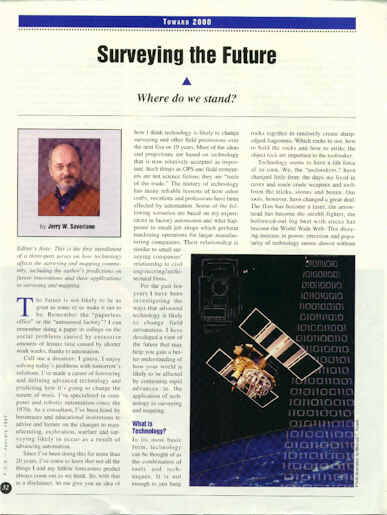
First Page of POB artcile
The POB version was
edited to reduce the length of the article and toned down
to offend fewer people. I thank POB for letting me
publish this "Directors Cut" of the article on
my Web site. Like most "Director Cuts" this
version is longer, and I hope it is more fun,
controversial and energetic in it's original form.
There are more mistakes and more
opinions here - shoot me an email if you find errors or
disagree with my findings.
Introduction
The future is not likely to be as
great as some of us make it out to be. Remember the
"paperless office" or the "unmanned
factory," or I can remember when I was in college
doing a paper on the social problems caused by excessive
amounts of leisure time caused by shorter work weeks,
thanks to automation. It's like some people's rosy view
of the past is effected by nostalgia. I'm not sure what
the future version of nostalgia is called, euthanasia?
But, I believe I suffer from it.
Call me a dreamer, I guess. I enjoy
solving today's problems with tomorrow's solutions. I've
made a career of foreseeing and defining advanced
technology and predicting how it's going to change the
nature of work. I have specialized in computer and
robotic automation since the 1970's. As a consultant I've
been hired by businesses and educational institutions to
advise and lecture on the changes to manufacturing,
exploration, warfare and surveying likely to occur as a
result of advancing automation.
And since I've been doing this for
over twenty years I've come to learn that not all the
things I and my fellow forecasters predict always come
out as we think. So, with that as a disclaimer, let me
give you an idea of how I think technology is likely to
change surveying and other field professions over the
next 5 or 10 years. Now, I'm not just going to make this
stuff up. Most of the ideas and projections are based on
technology that is now relatively accepted as important.
Such things as GPS and field computers are not science
fiction they are "tools of the trade." The
history of technology has many reliable lessons of how
other crafts, vocations and professions have been
effected by automation. Some of these scenarios are based
on my experiences in factory automation and what happened
to small job shops which perform machining operations for
larger manufacturing companies. Their relationship is
similar to small surveying companies relationship to
civil engineering/architectural firms.
For the past few years I have been
investigating the ways that advanced technology is likely
to change field automation. I've worked with surveyors in
the field. I've attended, worked and lectured at the
latest technology conferences and shows. I've conferred
with industry leaders and debated with dealers and
magpied with magazine editors about the future of
surveying and mapping. I have developed a view of the
future that may help you gain a better understanding of
how your world is likely to be effected by continuing
rapid advances in the application of technology in
surveying and mapping.
The technological imperative
Technology seems to have a life
force of its own. We the "tool makers" have
changed little from the days we lived in caves and made
crude weapons and tools from the sticks, stones and bones
which were strewn in our primitive front yards. Our tools
however, have changed a great deal. The flint has become
a laser, the arrowhead has become the stealth fighter,
the hollowed-out log beat with sticks has become the
world wide web. This dizzying increase in power,
precision and popularity of technology seems almost
without limit. Like the Arms Race the race in
productivity tools is pushing and challenging us each day
to keep-up and not fall behind. "Is this robotic
total station fast enough? Can I wait six months to buy
that RTK/GPS system. Am I jeopardizing my company by not
investing soon enough in advanced technology? Do we have
a Technology Gap?"
Isaac Asimov, the prolific writer
who gave us the term "robotics", defined the
Frankenstein Syndrome as the expectation of people that
our creations and inventions will be our undoing. From
the malevolent chaos let loose from Pandora's box, to the
technology busting Ludites, to Rachel Carson's
"Silent Spring" we have fought, resisted and
struggled with technology and its effects. Certainly
technology is a two-edged sword: it can be used as a
competitive weapon against our opponents and it can also
overwhelm our organization and become a technologic
anchor which drags our ship down to a gleeful Davy
"Murphy" Jones who adds it to his locker's
techno junk pile.
Surveyors and other field
professionals are split on the use of advanced
technology. A few aggressively employ high tech tools,
many bury their heads in the sand and hope they will be
able to get by without having to buy and learn another
new damnable device, most wait and see if their
colleagues and competitors make effective use and money
with new tools before they invest. Many surveyors are
fearful and reluctant to learn about new technology. They
view it with distrust and suspicion. Even though
technology - which can be defined as the combination of
tools and techniques - has always been a critical element
in the surveying profession.
The tools and instruments a
surveyor uses have changed more in the last 25 years that
they did in the previous 2,500 years. With the advent of
electronics, computers, communications and advanced
optics the modern surveyor can do more work, faster and
more accurately, with fewer people than ever before.
There will be no turning back. Once the genie is out of
the bottle he seldom returns. The important question is
how will advancing technology effect your business and
can these changes be put to your advantage.
Who can best exploit new technology?
Tradition and authority go hand in
hand. The people who are often most threatened by new
technology are the "old guard." Those who have
worked their way up over the years. Learning their jobs
the old fashioned way - by doing it. Progressing up the
ladder of success a rung at a time, based on what and who
they knew. It's the new kids in town who have the most to
gain by exploiting new technology to leap frog over the
old guard. Technology has no respect for tradition. It
does not inherently admire the aged nor the wisdom of the
ancients. Like all tools technology must be used
appropriately in order to achieve positive results.
Technology is the lever which can be used by the young
and aggressive to displace the old and entrenched.
Upstarts have the advantage! The technologically adept
will be able to progress more quickly within medium and
larger firms and as a small or sole proprietor surveying
company they will able to attract more jobs and earn more
profits through the intelligent application of advanced
technology.
This is not to say that tools make
the craftsman. A new robotic total station or an
expensive RTK/GPS system will only get you into trouble
quicker if you don't know your craft. These assumptions
are based on comparable talents and skills. Just like a
nice new set of power tools cannot assure that you will
build a quality house. But, assuming you and your
neighbor are about equally skilled, you should be able to
enjoying a glass of wine in front of a cozy fire in your
new home, ahead of your neighbor, thanks to the advantage
your power tools gave you over your hand-tooled
competitor. What is truly needed is a healthy balance of
tools, techniques and talent. And since we must work in
teams in collaboration with other people and groups we
must be able to manage projects and change in cooperation
with others.
The introduction of new technology
can provide advantages to people, companies and firms
which are agile and customer or client oriented. Larger
companies and agencies must struggle reengineering their
traditional, and thus far successful hierarchical
structures which are reluctant to change and adopt new
technologies and methods. It's harder to change things
which work , "If it ain't broke don't fix it."
mentality. Small, focused, aggressive companies can adopt
new tools and apply them in innovative ways to satisfy
client needs. Like the human's mammal predecessors
surviving and then thriving in a world dominated by
dinosaurs, their facile minds and versatile hands solving
problems close to the ground, living by their wits, day
to day, in the precarious underfoot dust and danger of
their dimwitted behemoth competitors.
Power to the People
One of the great ironies of
technology is the reverse "1984" effect.
Instead of a few giant electronic brains providing the
huge government/industry complex Big Brother like control
over our lives, (although this is always a concern,)
small micro computers on our desks, on our laps and in
our hands have provided The People, with an enormous
amount of technological power. Technology has proven to
be a great tool of democratization. Think of the
compelling image of the brave and foolish twin-bagged
shopper in Tiananmen Square blocking the advance of the
Chinese Army's tank. That image and many other images and
descriptions of peoples' heroism was broadcast on TV
around the world and narrowcast by fax and Internet -
"Knowledge is Power' and "The Truth Shall set
You Free." "Small is Beautiful."
"Power to the People!"
In a less dramatic, but in many
ways just as heroic a struggle is taking place in the US
and around the globe as small businesses and
entrepreneurs take on the Goliaths of the world. If you
own or run a small surveying or mapping firm you have,
pound for pound, a technological advantage over your
larger competitors. Your challenge is to focus on
providing your clients with high quality, cost effective
services. You must know which tools to buy, when to buy
them, how to best apply them, and how to recruit and keep
talented people.
To be sure, large and medium sized
companies and agencies are not just sitting there ready
to roll-over and let you take away their tasty business
bones. They too are trying to be more competitive and
focused on customer's needs. They also feel the threat of
global competition and privatization. They too have the
basic instinct for survival. Even though they are big,
they are frightened and their low octane adrenaline is
slowly pumping through their out-of-condition bodies.
(The smell of titanic spirit.) But they have greater
resources and can attract good people. They send their
managers and supervisors to workshops and seminars to
learn to act like a small responsive company. They
trouble is, it is an act! They can talk the talk, but can
they walk the walk? There is nothing more motivating and
focussing than being so close to the road that you feel
each bump and stone, you breathe the dirt and dust of
reality. You can smell the earth, the past, the future.
(Ashes to ashes, dust to dust.)
That is the real world. That is the
truth. When you are big and become isolated and protected
from the real world truth, your responses are more
sluggish, your feel for client problems are less deft.
It's like trying to assemble watches with mittens on. The
exception which proves the rule, of course, is a company
like Microsoft. Although mammoth and rich beyond greed,
Microsoft has the body of the dinosaur but the mind and
instinct of a frightened road runner …MEEP
….MEEP! It still is a jungle out there folks. And we
need the best tools, techniques and teammates to survive
and win.
It's not taught in schools
You'd think the kids coming out of
school would have an advantage using advanced technology.
It is true that most students in college today get a lot
more hands-on computer time and are likely to be more
comfortable with CAD systems, the Internet and other
computer driven tools. However most schools are hard
pressed to keep up with advancing technologies. New tools
are expensive and teachers and professors have difficulty
in keeping pace with the rapidly evolving technology.
What today's practicing professionals need to know about
technology is not taught in the schools.
You are responsible for seeking out
critical information for your firm's success. Your best
source of information on the latest advances in
technology are trade magazines, shows and conferences,
your local dealer's workshops and showroom, and hands-on
sales demos and loaners. The schools for the most part
are either too theoretical or too far behind the curve to
be high tech applications oriented. Your regional chapter
of the Land Surveyor Association should be a good source
of real world information and experience. If it isn't,
take an active role and make it so. You should also
develop a network of colleagues and contacts who you can
trust for advice and support.
You must continue with education.
You should always have something to read or study. You
have no time to lose. Surveyors asleep in a truck (what
has four wheels and sleeps six) is not a joke, it is a
tragedy. If it's raining, and you or your crew, goof-off,
go to the mall, waste the day - it is professional
negligence! Surveyors may wind-up on the endangered
professions list. Typesetters had a long honored
tradition and craft. But, they're just about gone. It
happens! Please don't be smug or take comfort in laws and
regulations which currently assure surveyors some
protection in boundary surveys. This is a small and
diminishing market segment and remember, "He who is
written in can be written out."
Take pride and joy in your
profession and, like you tell your kids about the
environment, leave it a little better off than you found
it. Think of those who've passed and, the hardship and
danger they overcame in the exploration and mapping of
this great untamed country. And think of those who will
follow and the technology rich and stressful world in
which they must live and work. Every day you must engage
yourself in your work, your craft, your tools. Things are
not going to slow down. They are in fact speeding up. As
we will cover in following sections, 1997 promises to see
dramatic increases in field productivity technology.
New technology presents an ever
increasing rate of progression. We sometimes feel
trapped, robot-like, servants to the machine or system,
struggling to keep up, like the conveyor belt workers
portrayed by Chaplin in "Modern Times" or Lucy
in the "Chocolate Factory" episode. And, there
are costs and losses for every advance in technology.
However, in the span of about a hundred years, the
journey the pioneers made along the Oregon Trail went
from a six month perilous adventure to a three day joy
ride - top down, radio on, at 65 glorious MPHs on the
great American highways. And who amongst us would give up
the power to surf 57 mindless channels with our wireless
remotes - talk about your Manifest Destiny! From hearty
pioneers to fatty couch potatoes - oh thank you
Prometheus, god of foresight, the great Titan who gave
Man fire and tools to elevate Man above the animals of
earth. Click…Click…
Reasons for Change
Life is change. Progress is
successful change. The world is not only smaller it is
faster. It took weeks before many Americans knew that
President Lincoln was assassinated, it took minutes for
the world to learn that Madonna had her baby. We are one
world and consequently now must compete with the guy down
the street and the gal across the sea. We are wired,
linked and connected. In the office and increasingly at
home, and now the final frontier, the field.
We once were protected by our
prowess in the wilderness. We are now threatened by GIS
geeks with purse sized GPS systems who are delighted with
football field sized accuracy. What in the name of Lewis
and Clark are we to do? Compete or die. The once
endangered American manufacturing industries have
responded to life threatening challenges from Japan and
Germany. Those companies which survived have flourished.
Chrysler now entices us with the Viper and Prowler, and
Harley still excites us with its throaty roar and neck
lashing power.
The large communication and
computing companies are continually restructuring,
reengineering, down and right sizing. We are even told
the federal government is re-inventing itself - sounds a
bit like doing your own brain surgery. DOTs and other
agencies are seeking to privatize to be more productive
and cost effective by outsourcing projects to private
companies.
There will be an increasing demand
for small, sharp, surveying firms to do work that was
once only the dominion of only the big firms and
agencies. Small agile firms also have the power of
passion. Owners and entrepreneurs and their motivated
workers can out produce their larger competitors through
team work, technology and a passion for personal
involvement and professional excellence. A large company
is like a sledge hammer - powerful but blunt. A small
company is more like an ice pick - sharp but persuasive
The manufacturing industries and
communication businesses have been put through tortuous
changes caused by advancing technology, the end of the
cold war and the global economy, over the last couple of
decades. And it's now our turn in the bucket. Every
change presents us with opportunity and risk. Flight or
fight, which shall it be? Where can you hide? Jump in and
enjoy the trip! Accept the challenge, be a Man or a
Woman. Be all that you can be. Better to have lived and
tried rather than to lurk in the underbrush hiding with
the other meek creatures - meek… meek,
click…click. "Which shall it be?" asks
H.G. Wells at the end of "Things to Come" How
about you, Bucky? Which shall it be?
End Part 1